

During the recent Gen Z protest against India’s education system, the youth counteracted intense state oppression with absurdist detachment demonstrated through viral social media reels. Rather than relying on traditional political vocabulary of empathy, the self-proclaimed ‘Cockroaches’ embraced delusional slapstick humour to reframe the narrative. Through the lens of Bertolt Brecht’s Epic Theatre, these comical acts function as a ‘Gen Z Gestus’ or ‘Zestus’. By rejecting the theatrics of empathy, commonly associated with any political upsurge, this absurdism triggers an alienation effect. People are prevented from sinking into the emotional narrative and instead are forced to confront political realities with a critical mindset.
Home page, text page and banner images are AI-generated for representative purposes
A paper leak, a digital outrage, and then a seismic protest, featuring a high-profile hunger strike. A social movement against a failing education system recently shook the entire nation, forcing the Union education minister to step down.
The state used all the coercive apparatuses at its disposal – lathicharges, water cannons, tear gas, detentions, internet blackouts and many more – to gag the voice of the youth: the Gen Z or the self-proclaimed ‘cockroaches’ – a name they proudly embraced after the controversial remark by the Chief Justice of India.
However, the movement's evolving language caught the state unawares, leaving it bewildered and struggling to respond through its traditional ‘legitimate’ means.
As the July 20 Sansad Chalo march grabbed eyeballs, posts, videos, and reels from the protest sites swamped the social media feeds. One showed people in Bihar waiting for the tear gas shells to detonate as the fumes created a perfect setting for a reel shoot – a situation whose tone can best be described by a Gen Z expression: 'LMAO'!
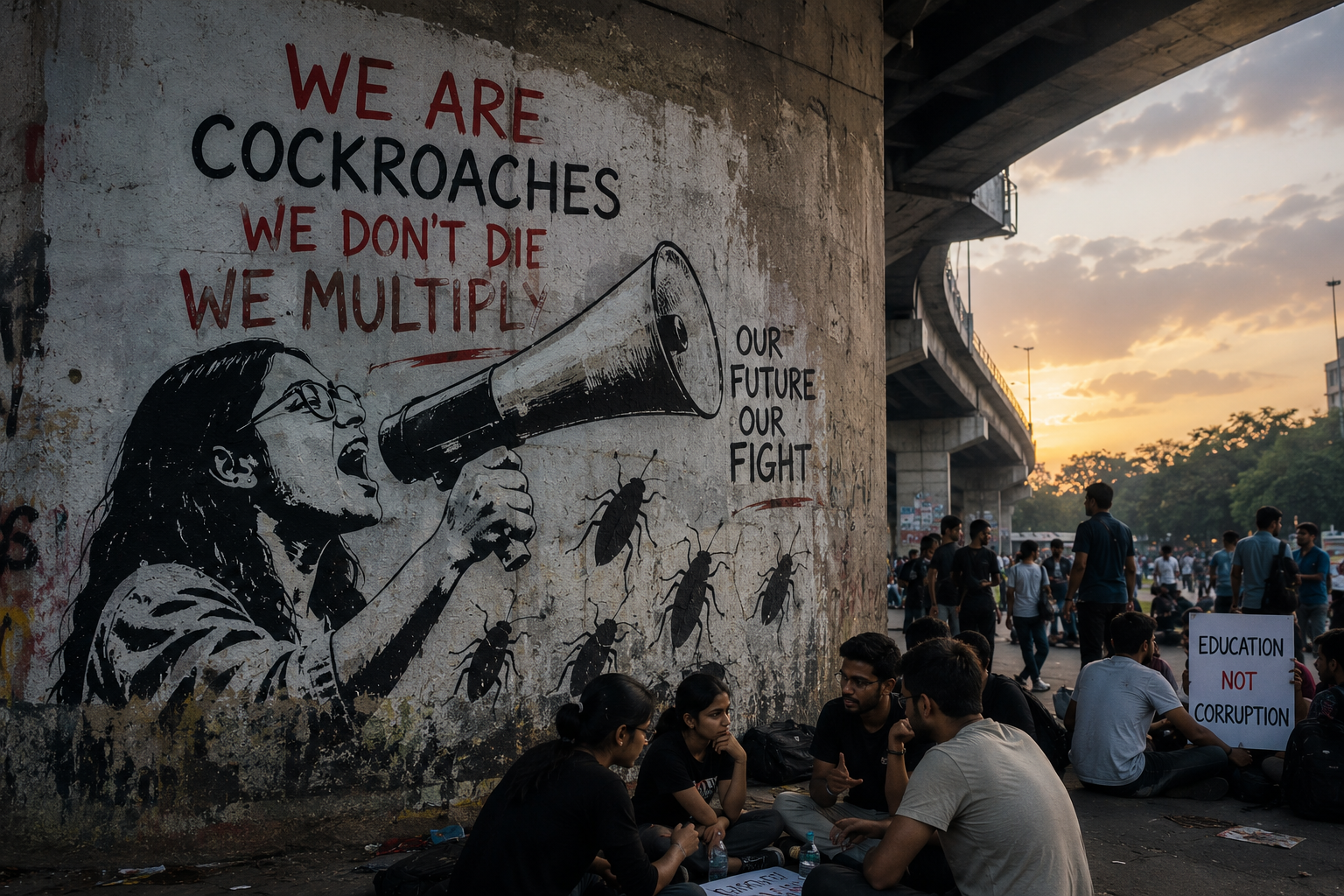
The image is AI-generated
Nonetheless, reels played a crucial role in this entire ‘something-like-a-movement’ that now probably needs a new name, more precise and more immortal like cockroaches, yet with a dash of laughter, as Gen Z prefers. While the ‘pookie’ intellectuals (used as a slang for an affectionate and affable thinking mind) can brainstorm over the coinage, let us delve into the essence of the reels made, watched, and widely shared over the last few weeks.
Diction, spectacle and catharsis
At a time when even the Baby Boomers, let alone the Millennials and Gen Zs, scroll through hours (or kilometres?) of Instagram/Facebook/YouTube reels and memes, using this to spread a particular narrative is not new.
For years, since 2014, the Bharatiya Janata Party (BJP), the ruling party at the centre, itself has cashed in on this modern digital addiction to endorse its ideology and flagship projects and policies. The ‘cockroaches’ (led by the Cockroach Janata Party) just flipped their game, with a tweak in approach.
Before going into a juxtaposition of the social media game by the ‘cockroaches,’ let me invoke the Aristotelian tragedy at this juncture to analyse the rhetoric hitherto used by the state.
As Augusto Boal discusses in his book Theatre of the Oppressed, Aristotelian tragedy imitates good men – the virtuous ones – and their goodness portrays what a man ‘ought to be’; a larger-than-life human figure – the ‘hero’.
“Tragedy is an imitation of personages better than the ordinary man”, says Aristotle in Chapter 15 of the Poetics.
However, the normative principle of goodness corresponds to the “constitutional criteria, which are those that systematise the laws”, Boal remarks. A man should behave according to the Law because the legislators have, taking individual differences for granted, made the Laws such that a man achieves the utmost happiness. Any emotion (or desire) is said to be a vice if that is not compatible with the existing Law.
Tragedy attempts to repress such vicious behaviour by stimulating Catharsis through which the vices of men are purged (temporarily at least). This is the reason why a tragedy portrays the hero, the virtuous man, who, while climbing to the peak of his happiness, experiences a sudden fall and ultimately goes through terrible suffering, solely for some vicious emotion he possesses – the tragic flaw, the Hamartia.
The tragedy connects the hero and the spectator with empathy. This attachment, while emotionally taking the audience through the same tragic suffering as that of the hero, culminates in the purgation of the ‘unlawful’ Hamartia.
Empathy stimulates two emotions among the spectators: pity – “such a character must not suffer in this way,” and fear – “the same thing might happen to me as I also possess such vicious emotions.”
The catastrophe of the tragedy stimulates a cathartic experience among the spectators, and they are expected to get ‘purified’ by purging the ‘tragic flaw.’ The tragedy therefore represses any ‘undesired’ emotion to maintain a status quo.
The theatrics of politics
From this vantage point, if we look back, what do we see in retrospect? In the past 12 years, the three-time elected National Democratic Alliance (NDA) government, led by Prime Minister Narendra Modi, has consistently sought to tickle an emotional nerve in the masses through its slogans and symbolism.
To infuse hope, the state’s information and mass communications apparatus launched populist one-liners like “Modi hai to mumkin hai” (Only possible if PM Modi is there). The image of PM Modi here serves as a rhetoric of virtue; any disagreement with or ‘disbelief’ in this ‘non-biological’ messenger of god might end up as an ‘undesirable’ tendency.
Prime Minister Modi also ditched press conferences and instead preferred to reach out to the nation through his social media handles as well as the “Mann ki baat” (talking from the mind) – a monthly radio programme with a title that screams emotion and empathy.
Operation Sindoor serves as another stark example where the name and the emblem carried emotional and cultural (and strategic as well) symbolism: The visual of a spilt bowl of sindoor (vermillion) instantly evoked the tragic memory of sacrifices that the nation bore, and the cries of the Hindu women widowed in the strike.
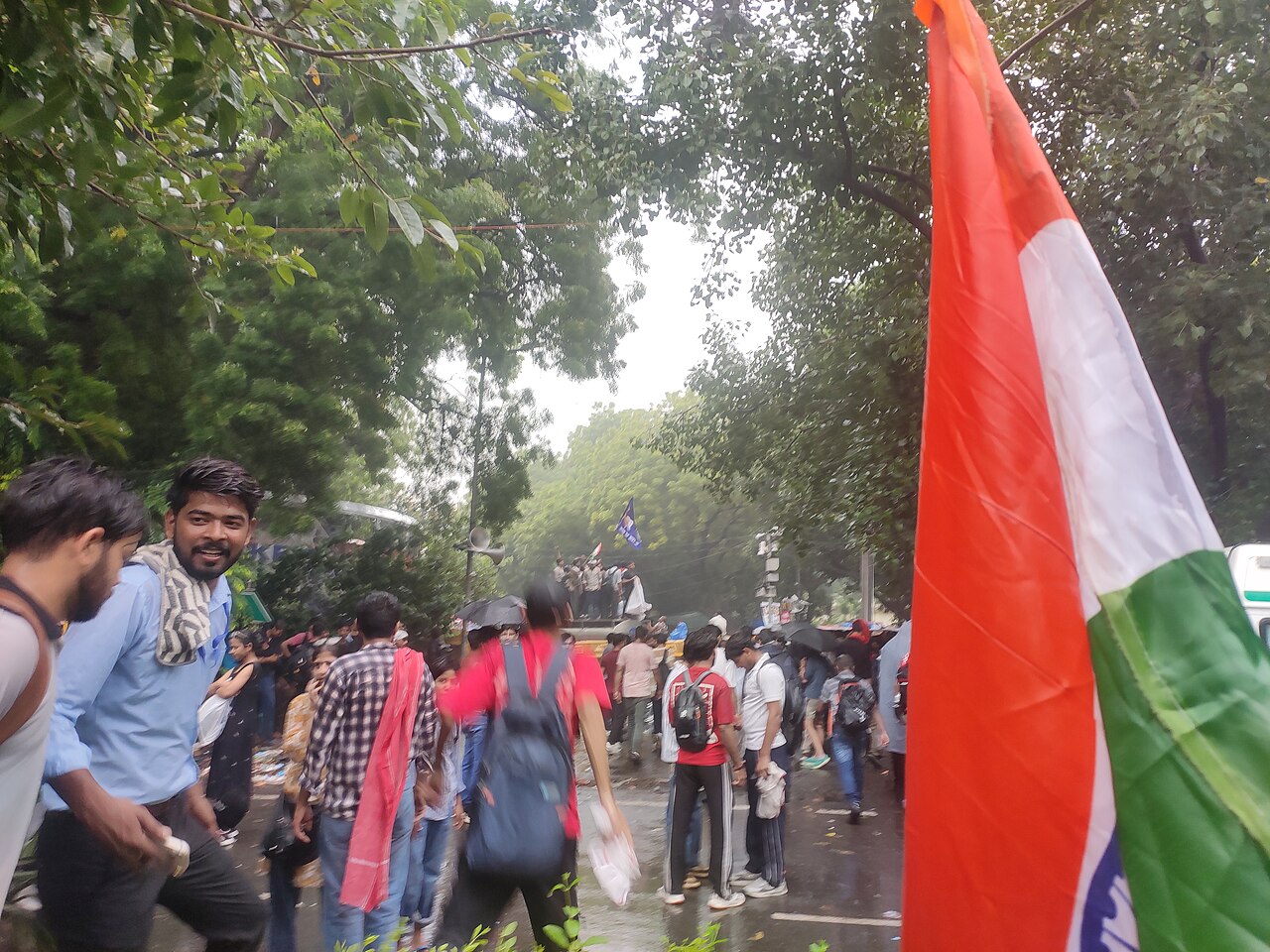
Students protesting at Jantar_Mantar on July 20, 2026, ahead of the Parliament March; photo credit - Sumita Roy Dutta
The entire political theatrics of the nation were centred around this empathy. Such empathy culminates in a catharsis, navigating the social psyche towards supporting and eagerly engaging in the discourse of war in this case, discussing why war was the only solution.
The rationale behind labelling it a catharsis lies in the purgation of tolerance and critical thinking (emotions required to be tolerant are considered as negative emotions in the dominant narrative – in Aristotelian terms, the Hamartia).
While the state continues to rely heavily on emotional or empathetic rhetoric, Gen Z counters it with absurdist detachment – the fundamental foregrounding of the recent Cockroach Janata Party (CJP)-led protests.
As opposed to the empathic political narrative, be it the dominant one or the counter one (as used in the hitherto movements as well), Gen Z, with their exceptional tech-native capabilities, changed the language of the discourse through reels; a new political vocabulary that can at times seem delusional.
Stand-up comedian Abhijit Ganguly says the apparent serious tone of the protest has been junked by Gen Zs with their crazy attitude. “Hasi aa hi jayga yaar aap ko (you can’t help but laugh),” he says, in one of his videos.
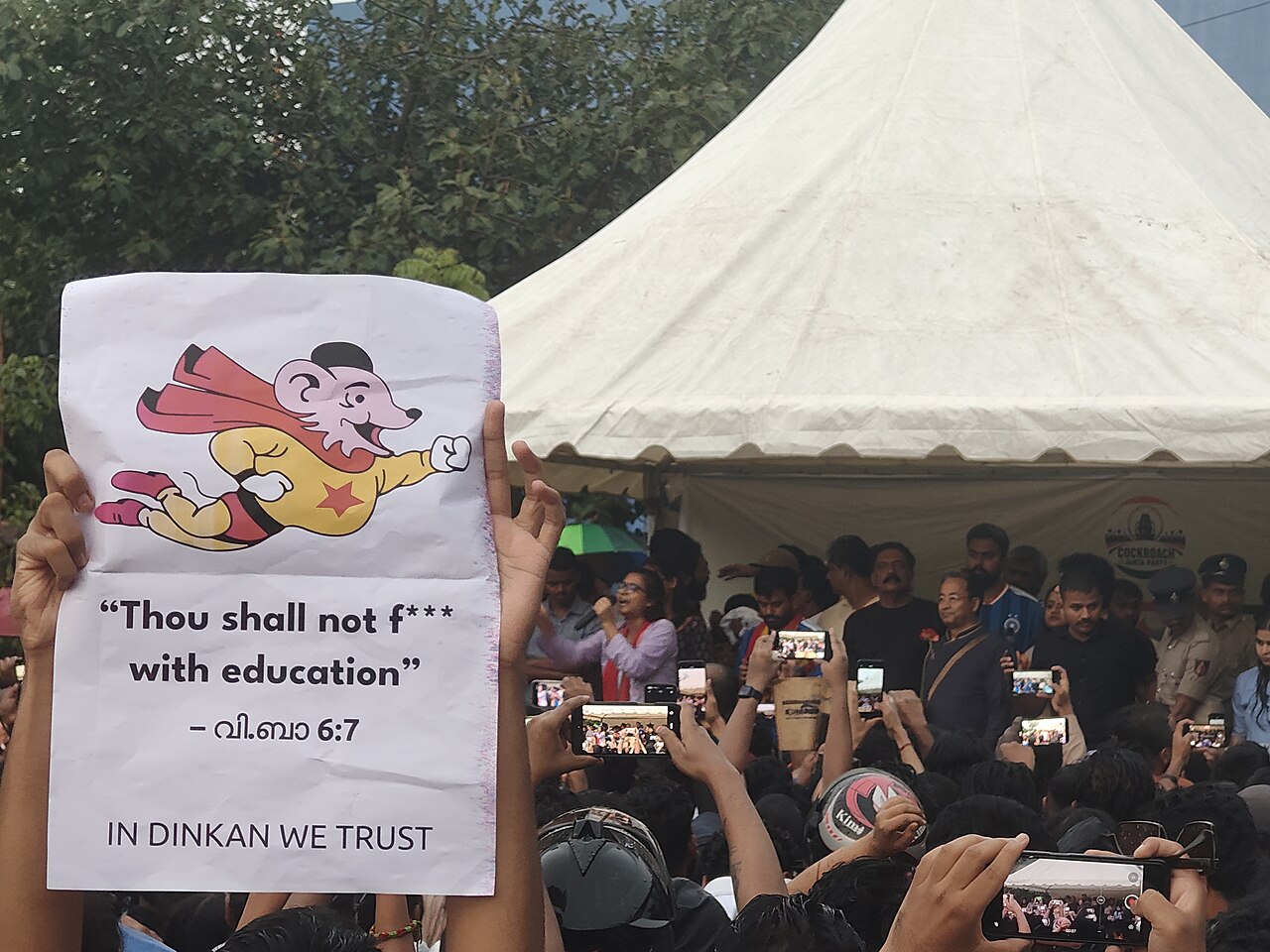
Poster with Dinkan, a cartoon character, during the protest in Bengaluru; photo credit - Subin Siby
And often, this generational craziness and absurdity are dismissed by many as “delusion.” Yet, Dharmendra Pradhan’s resignation as the Union education minister has shown us that this ‘delulu’ (delusional) can be quite an impressive ‘solulu’ (solution).
What changed fundamentally in the language of the counter-narrative? And how did the changed theatrics work to successfully drum up enormous support to bring a stubborn cabinet down to its knees?
The Brechtian vocabulary
Borrowing a lens from German theatrician Bertolt Brecht, the answer lies in the emotional disconnect that Gen Z successfully established. The primary objective of the Brechtian conceptualisation of Epic Theatre is to intervene in the domain of ideology.
The intervention could be such that a critical consciousness among the spectators can be stoked, and they can act upon the articulated radical ideas (one can refer to J. Willet edited Brecht on Theatre: The Development of an Aesthetic and T. Kuhn, S. Giles, & M. Silberman edited Brecht on Performance).
The comical acts and viral reels of an apparently nonchalant Gen Z prevented the audience from being carried away by the otherwise grim protest dynamics, involving a deplorable police crackdown.
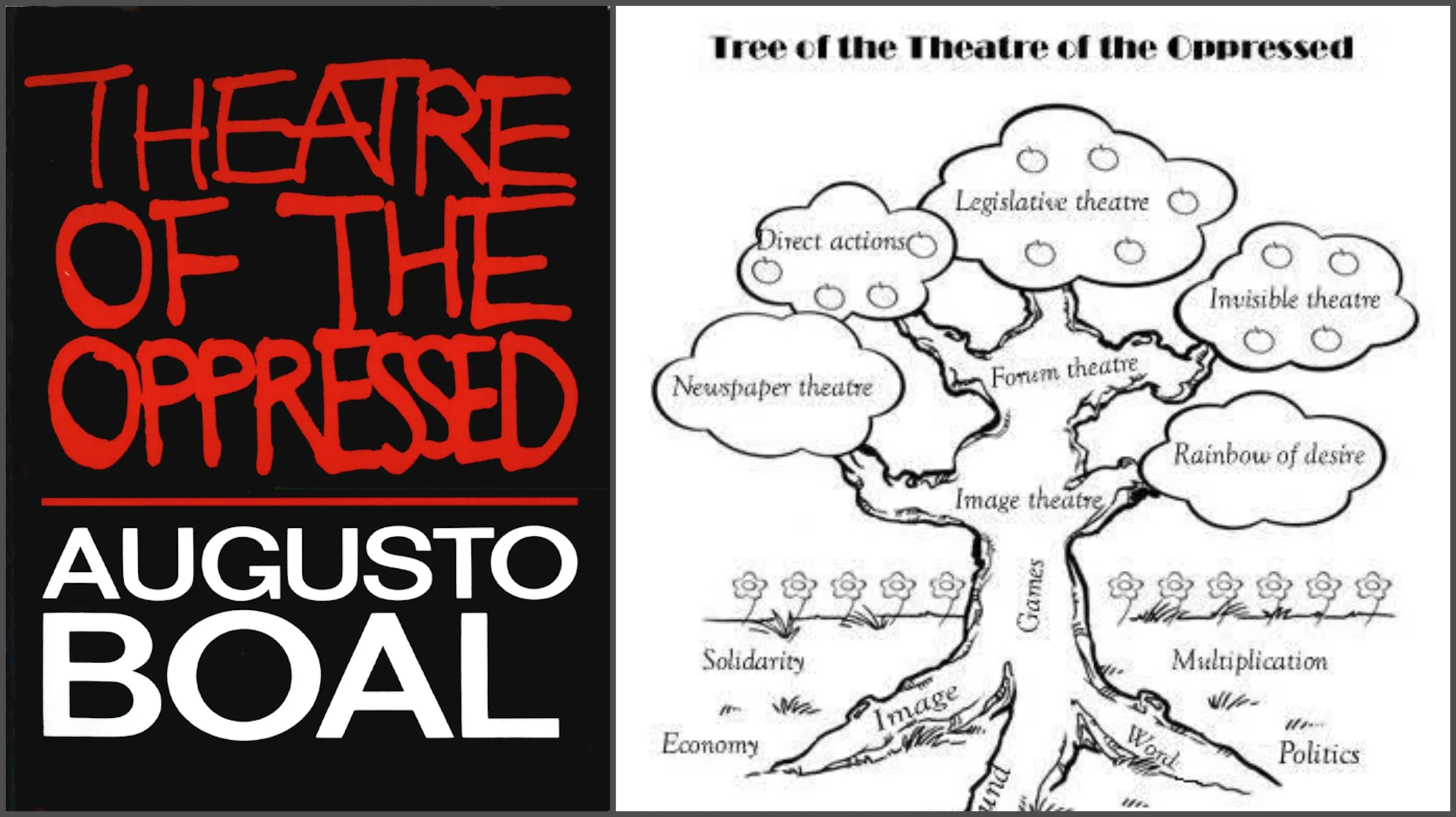
Brecht believed that emotional connection with a storyline makes the audience passive, shifting their focus from the actual cause. Instead of the empathic enactment of classical theatre, Brecht thus preferred to remain ‘scientific’, setting an ‘epic’ tone for his theatre.
It goes thus: The actors anchor the performance so that the audience does not get emotionally hooked to the storyline but thinks critically, thereby stimulating radical political thought. Brecht did not let the spectators “‘live’ the play by ‘identifying’ themselves with the hero, that is, with his time, with his consciousness,” remarked Althusser.
For this, Brecht uses Gestus, meaning a gesture with a social commentary. Suppose, when a soldier salutes, it is a gesture. But a soldier saluting amid a pile of bodies is a Gestus – a gesture with a social commentary. Here the audience is instantly alienated from the storyline, and can focus on the socio-political commentary underneath.
Gestus, therefore, stimulates the ‘alienation’ effect (the V-effect). As Althusser says, “Brecht hoped to create a new relation between the audience and the play performed: a critical and active relation… He wanted to set the spectator … an actor who would complete the unfinished play, but in real life.”
Both Althusser and Balibar observe that Brechtian Gestus, arousing the Alienation Effect, was not a mere technique of acting but a philosophical critique of the existing dominant philosophical lens.
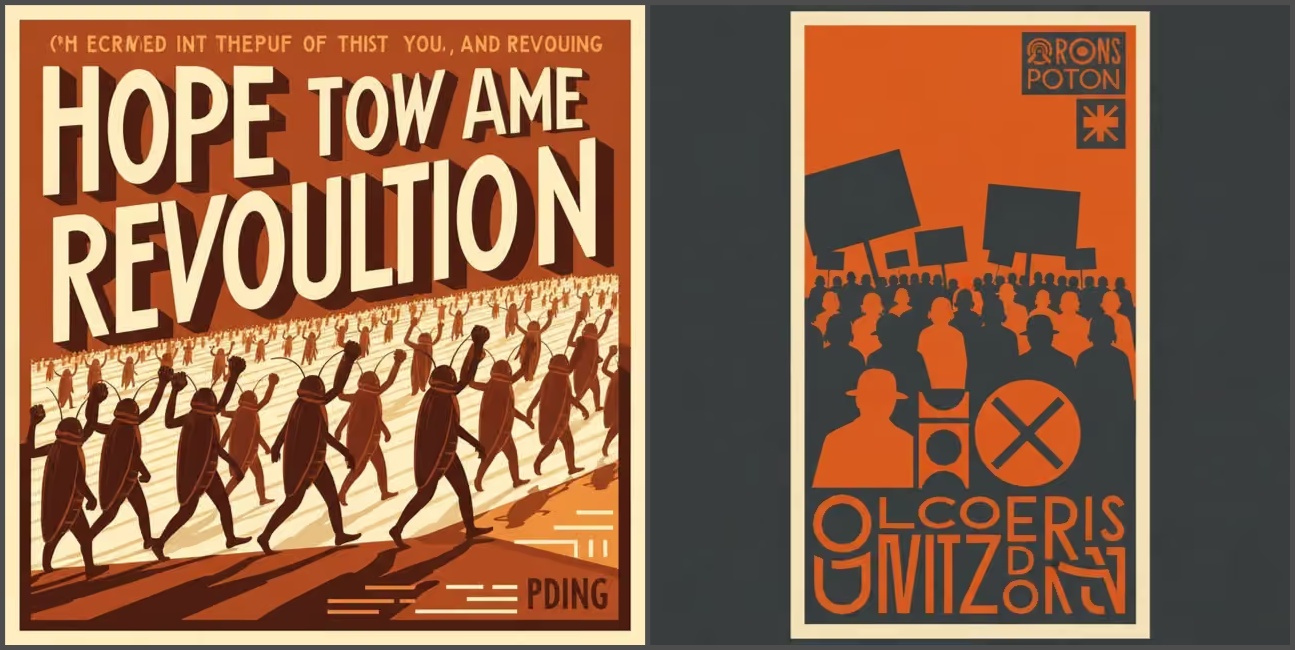
Posters exhibited by the CJP on its website
Is it possible to read the ‘delulu’ of Gen Z, expressed in the reels of the protest, as the ‘Gen Z Gestus,’ or simply as ‘Zestus’? Do the changed theatrics of a counter-(reel)narrative alienate the masses from empathic connection with any narrative, and pave the way to objectively focus on the real issues with a critical mindset? Does this unpack the possibilities of a long-term ‘solulu’?
A closer look at some popular reels may shed some light. A viral clip shows a protester being struck hard on his butt by the police. Instead of the natural instinctive response of running in the opposite direction, the guy turns towards the police and starts dancing.
The song that plays in the background is: “These are my private parts/nobody should see them/ nobody should touch them…” The people watching the reel cannot feel pity, fear or anger but laugh, realising how the state dictum is withering away.
The dance thus no longer serves as a gesture alone, but a Gestus that alienates the audience from empathy. The reel works as a slapstick, forcing its watcher to confront the actual socio-political scenario: the state’s coercive illusion, functioning in the disguise of fear, has already been falsified by those it seeks to suppress.
‘Delulu’ turns into a ‘solulu’
From using police shields as umbrellas, playing badminton across police barricades, requesting them to turn on water cannons to beat the heat, to bidding goodbye to the security forces, saying, “Uncle, meet you again in protest against Nitin Gadkari,” are examples of the delusional craziness of Gen Z turning into hilarious (Slapstick) Gestus.
One cracks up instinctively. But once you catch your breath, you meet the socio-political reality in the eye, without any veil of traditional tragedy and empathy.
The CJP chief spokesperson Saurav Das says, “We (Gen Z) can sit on the roads for as long as it takes. We can protest while dancing. We can organise while sipping cold coffee. We can fight for change without looking the way previous generations think a movement should look (no shade to anyone!)”.
A ‘solulu,’ thus unleashed, engages with one of the endangered ideas nowadays – critical thinking.
(Views expressed in this report are the author's own.)
Follow us on WhatsApp
Follow us on Facebook
Follow us on X @vudmedia
Follow us on Substack
