

The difference between welfare and justice often lies in one small question: can a hungry person ask, or must they wait? This question frames Rejimon Kuttappan’s examination of the shift from MGNREGA’s legally guaranteed right to work to the VB—GRAM Bill, 2025. Where a guarantee once recognised poverty as a shared responsibility of the state, discretion now threatens to make survival conditional on approval and timing. The assurance that allowed ordinary citizens to approach the state without folded hands begins to fade. With this change, development begins to resemble an abstract promise, repeatedly postponed rather than realised. A country moves forward not by rebranding its ambitions, but by ensuring that in moments of need, the state’s door opens as a duty—not a favour, says Kuttappan in this analysis of MGNREGA vs VB-GRAM.
Text page image: Prime Minister Dr Manmohan Singh at the launch of programmes under the National Rural Employment Guarantee Act (NREGA) at Bandlapalle village, Anantapur District of Andhra Pradesh, on 2 February 2006, along with Sonia Gandhi and other leaders
Home image image: MNREGA workers at a site
Banner image: MNREGA at a glance
Before 2006, Bandlapalli village in Andhra Pradesh’s drought-ravaged Anantapur district embodied the harsh realities of rural deprivation. Perennially parched, with no surface water storage and an unreliable groundwater table, rainwater simply drained away to distant tanks.
Families like that of Cheemala Peddakka, a Dalit widow, survived on a meagre INR 20 a day for backbreaking farm labour. Hundreds of households, most able-bodied workers, migrated annually to Bengaluru, leaving farmland idle and communities fractured.
In this elevated Rayalaseema plain, chronic poverty, mass migration, and entrenched gender wage gaps extinguished hope.

On 2 February 2006, that hopelessness was disrupted. The then Prime Minister Dr Manmohan Singh, accompanied by Sonia Gandhi, the then chairperson of the National Advisory Council, chose this remote village in Narpala mandal to launch India’s National Rural Employment Guarantee Act (NREGA)—renamed as the Mahatma Gandhi National Rural Employment Guarantee Act or MGNREGA in 2009—marking its first implementation anywhere in the country.
In a historic ceremony, they distributed job cards to five beneficiaries, including Peddakka, entitling them to 100 days of unskilled manual labour annually at the minimum wage.
Backed by an initial allocation of INR 11,000 crore across 200 districts—13 of them in Andhra Pradesh—the Act transformed employment into a legal right, promising “a life of self-respect and dignity” to millions of rural poor.
PM Singh described it as revolutionary, strengthened further by transparency mechanisms under the Right to Information Act (RTI) and panchayat-level oversight.
Over the next fifteen years, the infusion of wages and material investments reshaped Bandlapalli’s landscape and livelihoods. Under the leadership of then sarpanch Velpula Narayana Reddy, villagers constructed watersheds along hill streams and built farm ponds to harvest runoff and recharge aquifers. Groundwater levels rose significantly.
Peddakka’s two-acre plot, once rendered useless by failed borewells, now supports groundnut and Bengal gram cultivation. Her daily wages under NREGA rose to INR 50, closing the gender pay gap, while wages outside the scheme now exceed INR 200. Her sons, also job card holders, regard her card as a “souvenir of change.”
Reddy’s own 17-acre holding, once barren with dry wells, now yields bottle gourd, maize, and pulses.
Today, Bandlapalli stands transformed—a green village where returned migrants cultivate horticulture for steady incomes. The programme has generated lakhs of person-days of employment, disbursed crores in wages, and invested millions in durable assets.
Hundreds of job cards remain active, and MGNREGA proved critical during the COVID-19 pandemic. From despair to self-reliance, Bandlapalli’s story reflects how the NREGA has become rural India’s enduring New Deal.
Peddakka’s experience mirrors MGNREGA’s transformative impact across rural India.
The law guaranteed up to 100 days of unskilled manual work per rural household each year, restoring dignity and economic security to millions since its inception.

Image: MNREGA statistics that tell a story
According to the Ministry/Department of Rural Development’s Annual Report 2024–25, MGNREGA provided employment and livelihood safety net, covering the entire country except districts with a 100 per cent urban population. The scale and social reach of the programme in the current financial year underscore its continued relevance.
As of 31 December 2024, MGNREGA had employed 5.11 crore rural households, generating 211.41 crore person-days of work.
True to its self-targeting design, participation among historically marginalised communities remains high, with Scheduled Castes and Scheduled Tribes accounting for 36.92 per cent of total employment and women constituting 57.94 per cent—figures that highlight the programme’s central role in promoting social inclusion and gender equity in rural labour markets.
Beyond wage employment, MGNREGA has strengthened long-term rural resilience. During 2024–25, 18.56 lakh works related to natural resource management were undertaken at an expenditure of approximately INR 19,324 crore, reinforcing water security, land productivity, and ecological sustainability.
Equally significant is the programme’s contribution to financial inclusion.
Wages are now routed through institutional channels, with payments made to over 12.89 crore active bank and post office accounts, integrating the poorest rural workers into the formal financial system.
Collectively, these outcomes reaffirm MGNREGA’s identity as a rights-based programme delivering employment, equity, ecological regeneration, and financial inclusion—objectives that remain critical amid rural distress and economic uncertainty.
Yet the current Bharatiya Janata Party–led Union government has steadily altered the character of the Act through a series of policy shifts and legislative manoeuvres. What was conceived under MGNREGA as a legal guarantee of work has increasingly been reframed as a discretionary welfare intervention, tightly governed by technological controls, conditionalities, and fiscal restraint.
Through renaming, restructuring, and the introduction of a new framework in the Parliament without meaningful public or state-level consultation, the Modi government has hollowed out the rights-based architecture of the Act.

Image: Union Agriculture Minister Shivraj Singh Chouhan presenting the VB-GRAM Bill in Parliament (left), and at a press briefing organised by the BJP (right)
This top-down transformation marks a clear political departure—from an enforceable entitlement rooted in social justice to a centrally controlled scheme driven by executive priorities—weakening both MGNREGA’s moral legacy and its promise of employment as a justiciable right.
When Parliament passed MGNREGA in 2005, it defied prevailing policy orthodoxy. Poverty was not treated as charity, nor employment as a by-product of growth. Instead, the right to work was converted into a legal entitlement enforceable against the state.
For millions—particularly women, Dalits, Adivasis, and landless labourers—MGNREGA was not merely a scheme; it was recognition, dignity, and bargaining power.
VB-GRAM – death knell for rural income guarantee?
Two decades later, with its replacement by the Viksit Bharat—Guarantee for Rozgar and Ajeevika Mission (Gramin) Bill, 2025, the moral and legal foundations of MGNREGA are being dismantled. Rural employment is being redefined as an administrative favour rather than a citizen’s enforceable right.

Image: Women, among the largest beneficiaries of the MNREGA, are likely to be most affected by the Bill
What is at stake is not simply policy redesign, but the erosion of one of independent India’s most significant social contracts with its poorest citizens.
MGNREGA’s radicalism lay in its clarity. Any rural household could demand work, and the state was legally bound to provide it within a stipulated time. Failure triggered unemployment allowance, converting administrative failure into fiscal liability and giving workers leverage over the state.
It acknowledged an essential truth: hunger caused by unemployment is a governance failure, not an individual one.
The VB-GRAM Bill abandons this principle. Although it retains the language of “guarantee,” it strips away legal enforceability. There is no obligation to provide work on demand, no statutory timeline, and no unemployment allowance when work is denied. The worker’s right to demand employment is replaced by the government’s discretion to decide when, where, and whether work will be offered.
This shift—from right to discretion—is ideological. Under Prime Minister Narendra Modi’s government, welfare is increasingly framed as conditional support rather than a constitutional obligation.
MGNREGA was deliberately demand-driven. Employment expanded during droughts, floods, agrarian crises, and price shocks because workers activated the system by seeking work.
The new Bill reverses this logic. Employment will be generated through pre-approved plans, mission frameworks, and administrative sanction. Workers no longer trigger the system; they wait for projects to materialise. Power shifts decisively from labour to bureaucracy.
For households on the margins—seasonal migrants, landless Dalit workers, single women, and the elderly—this shift is profound. Distress does not follow planning cycles. Hunger does not wait for approvals.
Exclusion, by design
The consequences will fall disproportionately on women. MGNREGA has been one of the most significant economic interventions in women’s lives since independence. Equal wages, proximity of worksites, childcare provisions, and predictable payments enabled rural women—especially Dalit and Adivasi women—to participate in paid work on their own terms.
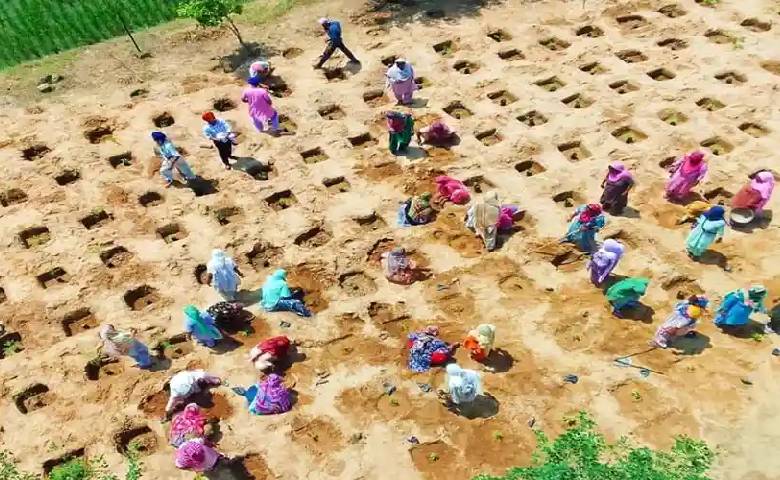
Image: Workers at an MGNREGA site
Today, women constitute nearly 60 per cent of MGNREGA workers, a direct outcome of its rights-based design.
VB-GRAM replaces this with technological compliance—biometric attendance, geo-fencing, digital monitoring, and productivity norms—that ignore the lived realities of women. Care burdens, health constraints, mobility restrictions, and digital exclusion are treated as individual failings.
When systems fail, women absorb the loss. Technology, presented as neutral efficiency, becomes a disciplinary instrument.
For Dalits and Adivasis, MGNREGA functioned as a counter-caste intervention. Guaranteed public employment reduced dependence on dominant-caste employers, weakened exploitative labour relations, and enabled collective assertion through social audits and Gram Sabha oversight.
The new Bill undermines these safeguards by shifting decision-making upward to executive-controlled bodies and diluting statutory accountability mechanisms.
This is not modernisation; it is exclusion by design.

Image: A horticulture farm (left) and a village pond (right) - that came up as part of MGNREGA scheme
Equally troubling is the impact on federalism. MGNREGA recognised employment guarantee as a national responsibility, with the Union bearing primary financial liability. VB-GRAM shifts operational and fiscal burdens onto states while retaining central control.
Authority without liability will force fiscally stressed states to ration access, leaving workers to bear the consequences.
Turning the idea on its head
Austerity, framed as efficiency, is a political choice. Underfunding rural employment while expanding corporate subsidies and capital-intensive infrastructure signals whose livelihoods are negotiable and whose profits are protected.
MGNREGA was a moral statement: that democracy must guarantee survival with dignity, not merely promise future prosperity. Naming the law after Mahatma Gandhi anchored it in an ethical tradition centred on the last person. “Viksit Bharat,” by contrast, is abstract and aspirational, asking the poor to wait for development rather than claim justice now.

Image: A playground on snow built as part of the MGNREGA scheme in the Himalayan region
This transformation did not occur overnight. Over the past decade, MGNREGA has been weakened through budgetary compression, delayed payments, technological gatekeeping, and rhetorical delegitimisation. The VB-GRAM Bill formalises this retreat, converting a rights-based law into a permission-based scheme.
Rural employment policy must evolve. Wages must rise, implementation must improve, accountability must deepen, and coverage must expand. But reform does not require dismantling rights. It requires political will.
Instead, the government has retreated from obligation while retaining control. Parliament must, therefore, ask not whether VB-GRAM sounds ambitious, but whether it strengthens or weakens the ability of the poorest citizens to hold the state accountable. The answer is unambiguous.
A nation cannot become “Viksit” by stripping its most vulnerable citizens of enforceable rights and calling it efficiency. The real cost will not appear on dashboards, but in migration, indebtedness, unpaid care work, and silent hunger.

Image: CPI(ML) activists protest the repeal of MGNREGA
MGNREGA was never perfect. But it was honest. It placed responsibility on the state and dignity on the worker. Replacing it with a discretionary, centralised framework is not progress. It is a regression—away from justice, accountability, and the constitutional promise made to rural India.
If development demands that the poor surrender their rights in exchange for hope, the price of “Viksit Bharat” is far too high.
(Views expressed are the author's own.)
Follow us on WhatsApp
Follow us on Facebook
Follow us on X @vudmedia
Follow us on Substack
