

Oman, Jordan and Ethiopia are three distinct nations that play a significant role in the geo-strategic junction of West Asia and North Africa, also known as the WANA region. Prime Minister Narendra Modi’s recent visit to these countries was a significant diplomatic outreach, which might seem symbolic on the exterior, but has far-reaching strategic dimensions with geo-economic and geo-civilisational implications. At the core of this outreach is a carefully-scripted game plan that showcases how India chooses connectivity over coercion, development over military deployment, and strategic autonomy over bloc acrimonies in what seems to be an interconnected strategic theatre spanning two subcontinental peripheries, says Professor Swaran in this 14th edition of Asia Watch.
Home image: PM Modi accorded a ceremonial welcome in Amman, Jordan, 15 December 2025
Text page image: PM Modi meeting legislators before addressing a joint session of the Ethiopian Parliament, 17 December 2025
Banner image: PM Modi received by the Ethiopian counterpart at the Addis Ababa Bole International Airport, 16 December 2025
Prime Minister Narendra Modi’s three-nation tour of Jordan, Ethiopia, and Oman from 15 to 18 December 2025 can be seen as a novel attempt to reconceptualise West Asia, the Red Sea, and the Horn of Africa as a single, interconnected strategic theatre.
It marked India’s maritime articulation of its conventional continental perspectives about the ‘West Asia North Africa’ (WANA) formulation of yore.
While the visit may have yielded limited headline-grabbing deliverables beyond the India-Oman Comprehensive Economic Partnership Agreement (CEPA), its deeper significance lay in this structural reimagining of India’s extended neighbourhood — where geo-politics, geo-economics and geo-civilisational diplomacy were fused into a single framework of India’s futuristic strategic engagement.
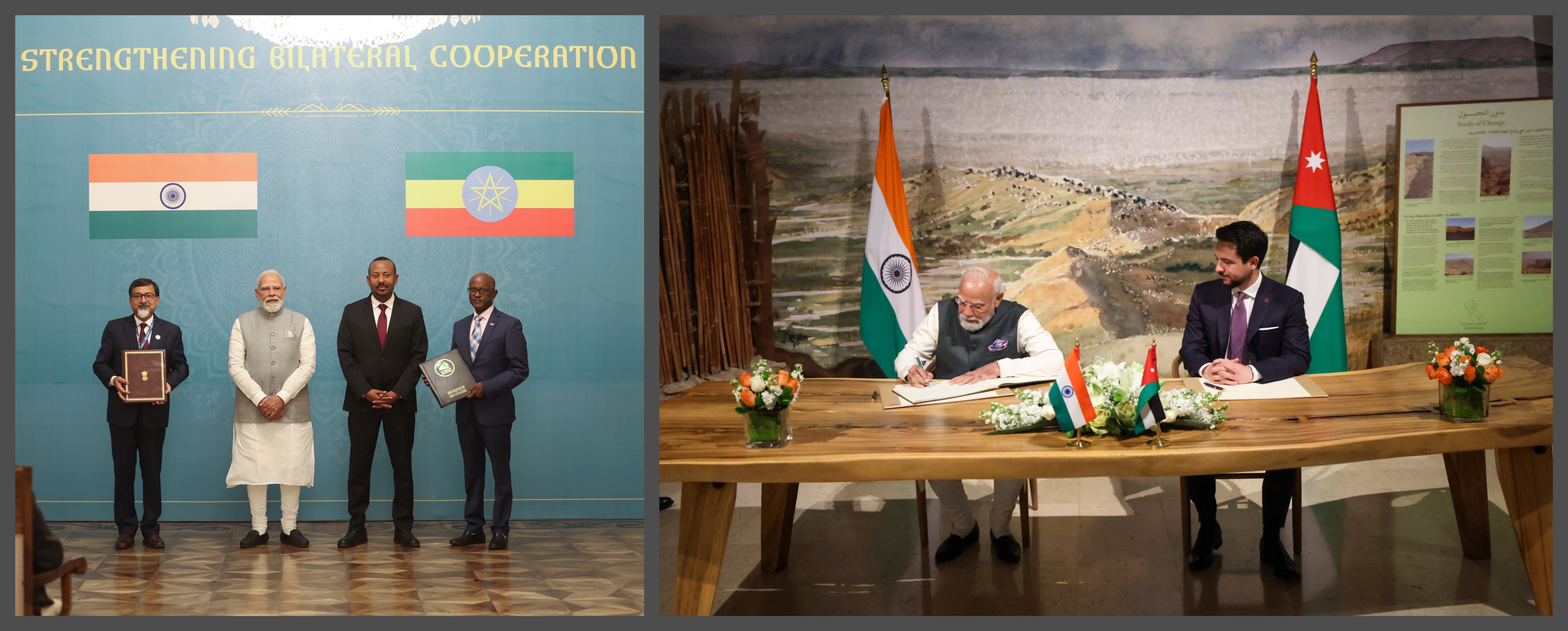
Image: PM Modi and Ethiopian PM Dr Abiy Ahmed Ali with their officials after signing MoUs at the Ethiopian National Palace (left), and PM Modi signs the visitors' book at the Jordan Museum in Amman with Crown Prince Al-Hussein Bin Abdullah II by his side (right)
Especially at this moment defined by Gaza war spillovers, Red Sea maritime insecurity, Houthi attacks on shipping, Ethiopia’s internal fragilities, and sharpening great-power rivalries, this visit presented an opportunity to showcase how India chooses connectivity over coercion, development over military deployment, and strategic autonomy over bloc acrimonies.
In this fractured geopolitical backdrop, therefore, this three-nation tour also represented continuity rather than rupture in India’s external engagement — but it also revealed the limits of India’s increasingly risk-averse statecraft.
One strategic space, three anchors
The unifying logic of the visit lay in its highlighting of the region’s maritime connectivity and indivisibility of regional security – linking the Western Indian Ocean, the Strait of Hormuz, the Red Sea, and the continental North Africa into a continuum.

Image: PM Modi at the Adwa Memorial and Museum in Ethiopia
Locating India in this new formulation shows each of these three nations playing a critical role in India’s pursuit of Viksit Bharat:
• Oman anchors India’s western Indian Ocean presence and guards access to the Strait of Hormuz, through which nearly 20 per cent of global LNG exports pass.
• Jordan, though not a maritime power, sits at the strategic junction of the Levant, influenced simultaneously by the Gulf security dynamics, Red Sea trade routes via Aqaba, and the destabilising effects of conflicts in Gaza and Syria.
• Ethiopia, landlocked yet a regional anchor for the Horn of Africa and pivotal to Red Sea stability, hosts the African Union headquarters in Addis Ababa, shaping security dynamics from Djibouti to Somalia.
Engaging these three countries illustrates India’s recognition that sea lanes, choke points and hinterlands are inseparable.
In this transforming geopolitical context, Prime Minister Modi’s December 2025 tour should be read as an amalgamation of India’s evolving multiple frameworks of “Look West”, “Think West”, and “Act Africa” that seem to now converge into a single West Asia–North Africa–Horn of Africa (formerly WANA) strategic theatre.
With global focus shifting from geo-strategy to geo-economics, India’s trade exposure underscores this logic of seeing these three nations as one continuum. In spite of India’s newfound access to Russian crude suddenly soared to over 30 per cent share of India’s total imports, West Asia still remains India’s largest supplier, accounting for over 42 per cent.
Before the start of the Ukraine war, this share had stayed over 60 per cent for the last 15 years. Simultaneously, India’s trade with Africa has doubled in the last five years, from USD 56 billion to crossing the USD 100 billion mark last year.
While South Africa remains India’s largest trading partner in Africa, Ethiopia has come to be India’s critical political interlocutor for Africa and the Global South, rather than a trade heavyweight, though its bilateral trade of USD 500 million is expected to grow faster now.
Understandably then, instead of talking about alliance-building, Prime Minister Modi’s visits emphasised South–South Cooperation, focusing on:
• capacity-building,
• food security,
• digital public infrastructure,
• healthcare and pharmaceuticals,
• and development partnerships.

Image: PM Modi with Omani officials (left) and with Sultan of Oman Haitham bin Tarik (right)
Oman CEPA as the centre-piece
The India-Oman CEPA was the most tangible outcome of the tour and the clearest signal of India’s geo-economic intent of Viksit Bharat. Bilateral trade, already hovering around USD 10.2 billion, is expected to now grow substantially with tariff reductions, investment facilitation, and services liberalisation.
Oman has offered India zero-duty access on over 98 per cent of its tariff lines, covering nearly all of India’s exports.
Beyond trade, Oman also stands as the gateway for the narrow Strait of Hormuz and acts as a critical partner for India across at least three domains:
1. Energy security — a stable and reliable supplier of crude oil and LNG.
2. Logistics and connectivity — since 2018, the Duqm port’s strategic utility complements India’s western maritime outreach.
3. Maritime security cooperation — joint naval exercises and information-sharing agreements reinforce India’s role as a benign net security provider.
India-Oman defence cooperation — India’s closest amongst the Gulf nations — has come to be the pillar of their strategic partnership. But unlike the United States, Britain, the former Soviet Union or lately China, India’s defence cooperation prefers presence without permanence involving naval visits, exercises, HADR, logistics access and diplomacy.

Image: A view of Aqaba, Jordan - popularised in the cult movie Lawrence of Arabia (left), and the Port of Duqm, Oman (right)
Therefore, in spite of being fully conscious about China’s growing forays into the Indian Ocean littoral and its naval base in Djibouti since 2017, India has avoided any move toward permanent basing or coercive leverage, maintaining Oman’s comfort amid Gulf rivalries.
Jordan-Ethiopia: Symbolism over substance
In Jordan and Ethiopia, the outcomes were more modest — Memorandums of Understanding (MoUs), joint statements, and declarations of intent on cooperation in education, ICT, agriculture and counter-terrorism. India signed five MoUs with Jordan and eight with Ethiopia.
Furthermore, India-Ethiopia also upgraded their ties to a strategic partnership.
Jordan, which became independent in 1946, had signed its first agreement with India in April 1947, before India became independent. But today Jordan’s significance lies less in economics and more in regional signalling.
As Gaza war spillovers have destabilised West Asia, India used this visit to Amman to reaffirm its preference for regional stability without overt mediation or military posturing. Yet critics have noted that India’s calculated diplomatic ambiguity on Gaza, which perhaps reflects India’s strategic autonomy, has also contributed to diluting its leadership signalling.

Image: PM Modi with PM Dr Abiy Ahmed Ali (left) and Jordan King Abdullah II bin Al Hussein (right)
Ethiopia presented a different challenge. As a linchpin of Horn of Africa security, Addis Ababa’s internal ethnic tensions and its fraught relations with neighbours pose risks to Red Sea stability.
Here again, India’s engagement remained cautious, avoiding public commentary on Ethiopia’s internal conflicts or its Red Sea ambitions — an approach consistent with India’s non-intrusive diplomacy, but arguably underwhelming given Ethiopia’s strategic centrality to Africa, where India has had a long history of engagement.
Civilisational connectivity and diaspora
A distinctive feature of the tour was its emphasis on India’s historical, civilisational and people-to-people linkages with these three nations that undergird their mutual policies and perceptions.
• Oman hosts one of India’s oldest overseas communities, with historical links dating back millennia through the Indian Ocean trade. The Bhatia’s from Kutch were the first to settle in Muscat there from 1507 AD, and Oman today is home to 700,000 PIOs.
• Ethiopia had seen a permanent presence of people from the Indian subcontinent since the late 1880s. But the Horn of Africa bears deep imprints of Indian mercantile and cultural interactions since early modern times, way before the British took them there as indentured labour.
• Jordan represents India’s softer civilisational diplomacy through education, tourism and cultural exchanges. Over 17,500 of them are now in Jordan engaged in textiles, construction and healthcare.

Image: PM Modi greeted by the Indian diaspora in Amman (left), and Addis Ababa (right)
India’s civilisational linkages with these three nations date back to the millennia through the Indian Ocean and Red Sea trade, cultural exchanges and pilgrimage routes.
Indian textiles, spices and ideas circulated via Arab intermediaries and their shared maritime histories, commerce and people-to-people cultural connections had shaped their mutual imaginations way beyond colonial European interventions.
This civilisational framing aligns with India’s broader attempt to embed modern geopolitics in historical connectivity, a theme increasingly visible in its global engagements, including those with the Indian Ocean littoral.
These connections must also be seen in the larger context of this region today being home for over 9 million people of Indian origin, and is a source for USD 50 billion per annum.
Structural gains, transactional limits
These visits also occurred amidst intensifying great-power rivalries in West Asia and Africa, yet India has avoided taking sides — on Gaza, on Red Sea militarisation, or on Ethiopia’s internal politics. This way India preserved its strategic autonomy, as also ensured energy supplies and safety of the large Indian diaspora, which has cost India in inviting criticism of diluting its leadership mantle.
This tour was also rather process-oriented rather than outcome-driven; rich in symbolism — like Jordan King and Ethiopian Prime Minister personally driving PM Modi from the airport to the hotel — but thin on hard political and security articulation.
It perhaps even reflected the novel vision of positioning India as a civilisational, economic and security partner across this region — leveraging diaspora ties, maritime connectivity, and development partnerships — but its credibility will depend largely on India's follow ups in the future.
Notably absent this time was any clear public articulation of India’s vision on specifics like the Red Sea security framework, despite mounting threats to global shipping, including that of India.
Optimistically put, Prime Minister Modi’s visits to Jordan, Ethiopia and Oman were perhaps less about immediate outcomes and more about strategic stitching — binding West Asia, the Red Sea, the Horn of Africa and the Western Indian Ocean into a single cognitive and diplomatic mental map for future.
From this vantage point, India may have sought to present itself:
• as a stabilising force without coercion,
• as a development partner without dependency,
• and a trusted interlocutor across rival blocs.

Image: PM Modi driven to the Jordan Museum by the Crown Prince Al-Hussein Bin Abdullah II (left), and in the car driven by Ethiopian PM Dr Abiy Ahmed Ali (right)
Cementing ties in WANA
In the end, Prime Minister Modi’s visits to Jordan, Ethiopia and Oman presented a case where the caution that seemed to have preserved India’s strategic autonomy also seemed to constrain its leadership and convening power.
The tour’s real achievement was largely symbolic or structural rather than transactional — laying down perhaps a long-term architecture for India’s regional engagement while postponing bold choices for tangible outcomes.
Without doubt, this region remains critical for fuelling India’s Viksit Bharat aspiration. But as is visible in most other interactions of recent months, in this Trump-triggered era of volatility, India has chosen patience over posture.
These produced limited new economic commitments, security initiatives or institutional mechanisms emphasising mainly civilisational links, political goodwill and continuity rather than major investments, defence agreements or transformative regional initiatives from a leading power.
Whether this restraint evolves into strategic leadership — or remains diplomatic minimalism — will define India’s role across this Western Arc in the years ahead.
Follow us on WhatsApp
Follow us on Facebook
Follow us on X @vudmedia
Follow us on Substack
